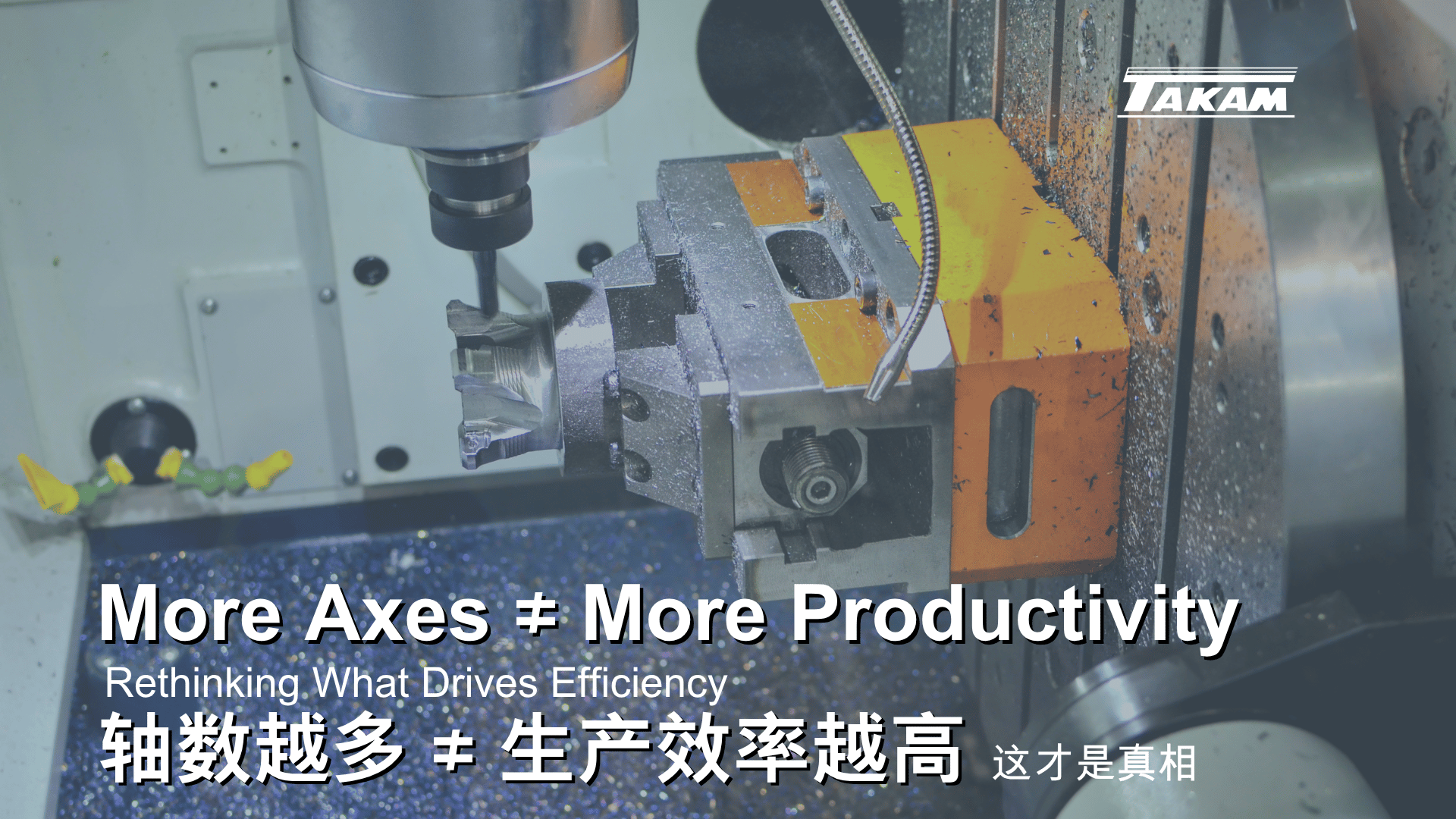
More Axes ≠ More Productivity---Rethinking What Drives Efficiency
Walk into almost any machine shop today, and you’ll hear a familiar belief:
more advanced machines should naturally lead to higher productivity.
More axes mean fewer setups.
Fewer setups mean faster production.
At least, that’s the expectation.
But if you look closely at actual shop floor performance, the results often tell a different story.
Many manufacturers invest in higher-axis machines with the goal of improving efficiency—only to find that output doesn’t increase as expected. In some cases, it even becomes harder to maintain stable production.
So where does the disconnect come from?
Capability Doesn’t Equal Output
There is no question that multi-axis machines are powerful.
They make it possible to machine complex geometries in a single cycle, reduce repositioning, and achieve tighter tolerances. From a technical perspective, they represent a significant step forward.
However, productivity is not defined by what a machine can do.
It is defined by what a system consistently delivers.
And that system includes far more than just the machine itself.
Where Productivity Is Actually Lost
In many workshops, inefficiency doesn’t come from cutting—it comes from everything surrounding it.
Parts wait between operations.
Operators intervene more often than expected.
Setups take longer than planned.
Even with a high-end multi-axis machine, if the workflow still depends on frequent stops, adjustments, and manual handling, the gains from advanced hardware are quickly diluted.
The machine may be faster.
But the process remains fragmented.
The Complexity Trade-Off
More axes don’t just add flexibility—they introduce complexity.
Programming becomes more demanding.
Simulation and verification take longer.
Operators need a higher level of experience.
And with every added variable, the risk of inconsistency increases.
This is often overlooked during the decision-making stage. The focus is placed on what the machine enables, not on what the organization can realistically execute.
As a result, companies sometimes invest in capability that exceeds their current process maturity.
Why Fewer Interruptions Matter More
If productivity isn’t simply a function of machine capability, then what drives it?
Flow.
The most efficient production environments are not necessarily the ones with the most advanced machines—but the ones with the least interruption.
Every time a process stops, something is lost:
- Time
- Stability
- Predictability
This is why reducing setups often has a greater impact than increasing axis count.
A Different Way to Look at Machining
Instead of asking how many axes a machine has, a more useful set of questions might be:
How many times is a part handled?
How many transitions exist between operations?
How often does the process rely on manual correction?
These questions shift the focus from equipment to execution.
And in many cases, they reveal that the biggest opportunity for improvement lies not in upgrading machines, but in simplifying the process.
The Role of Multi-Face Machining
This is where multi-face machining strategies become especially relevant.
By enabling multiple sides of a part to be machined within a single setup, manufacturers can significantly reduce handling and repositioning.
The benefits are not just about saving time.
They include:
- More consistent accuracy
- Reduced operator dependency
- Smoother workflow between operations
Instead of pushing machines to do more, the goal becomes allowing the process to do less.
Less interruption.
Less variation.
Less waste.
The Hidden Cost That Adds Up
Re-clamping a part may seem like a small task.
But each time it happens, it introduces:
- Alignment risk
- Additional setup time
- Increased reliance on operator skill
Individually, these effects are easy to ignore. Collectively, they can define the overall efficiency of a production line.
Over time, the cost of repeated handling often outweighs the benefit of increased machine capability.
Aligning Technology with Process
Advanced machines are not the problem. Misalignment is.
When machine capability and process design are not aligned, the result is underutilization at best—and inefficiency at worst.
Before investing in more complex equipment, it is worth considering:
Can the current process be streamlined?
Can operations be combined?
Can handling be reduced?
In many cases, answering these questions leads to more sustainable improvements than simply adding more axes.
Rethinking What Productivity Means
Productivity is often associated with speed.
Faster cutting.
Shorter cycle times.
Higher spindle performance.
But real productivity is about consistency and flow.
A slightly slower process that runs smoothly, predictably, and with minimal interruption will often outperform a faster one that requires constant adjustment.
The Real Advantage
The companies that gain a competitive edge are not necessarily those with the most advanced machines.
They are the ones that design better processes.
They reduce unnecessary steps.
They minimize variation.
They build systems that are easier to control and scale.
Because in the end, productivity is not about how advanced your machine is—
It’s about how efficiently your entire operation works together.
Flat Bed vs. Slant Bed — Why the Industry Changed
When Does CNC Automation Stop Making Sense?