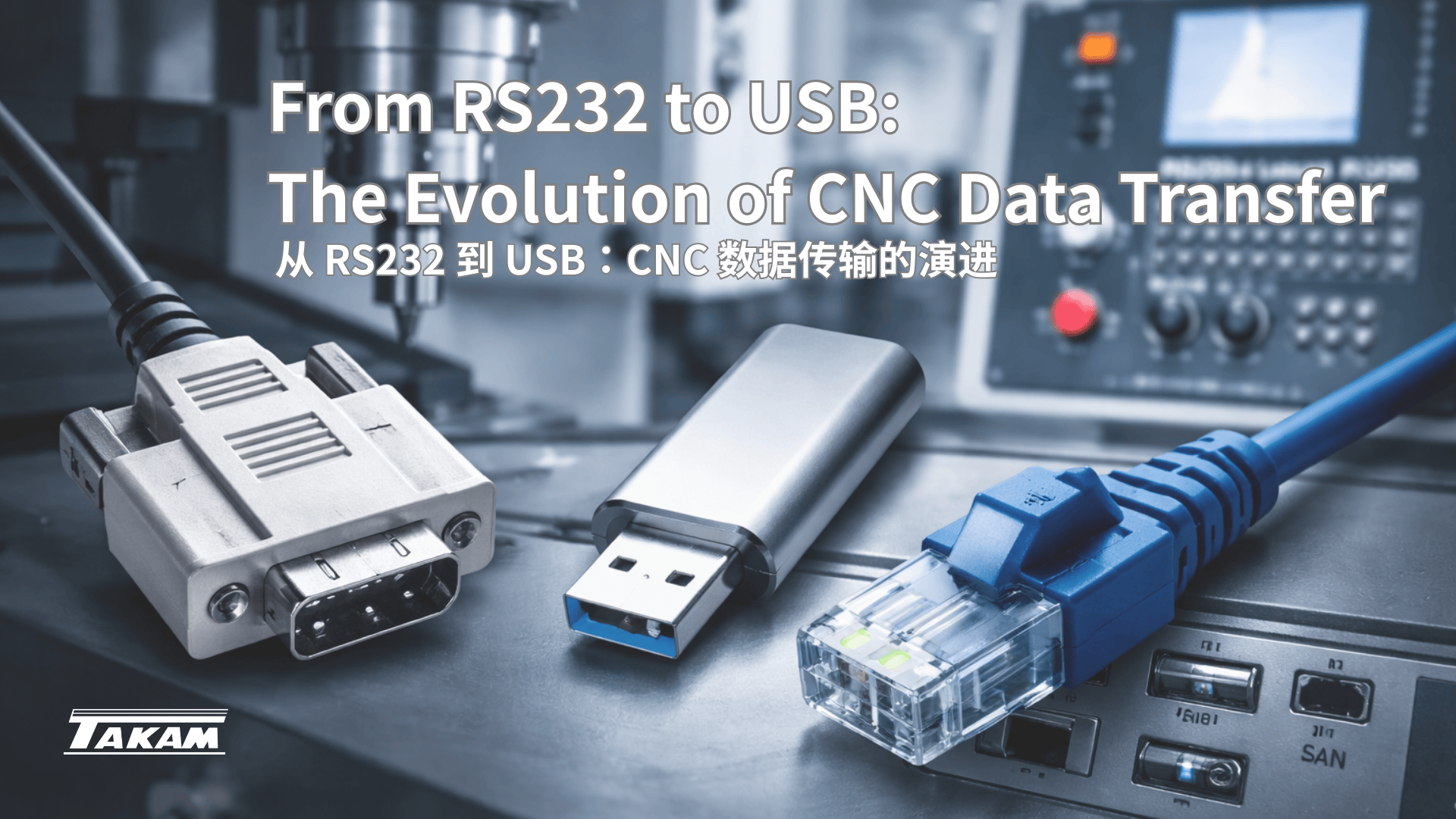
From RS232 to USB: The Evolution of CNC Data Transfer
In today’s CNC machining environment, conversations often revolve around automation, digital twins, smart factories, and fully networked production lines. Ethernet connectivity, MES integration, and cloud-based monitoring are becoming standard topics in industry discussions.
Yet, on the shop floor, a different reality often exists.
Despite rapid technological advances, CNC data transfer still relies heavily on physical interfaces such as RS232, USB, SD cards, CF cards, and RJ45 Ethernet ports. These interfaces may appear simple—or even outdated—but they continue to play a critical role in daily machining operations around the world.
Understanding how CNC data transfer has evolved—and why older and newer interfaces continue to coexist—offers valuable insight into how machines are actually used in real production environments.
The RS232 Era: Stability Before Speed
For decades, RS232 serial communication was the backbone of CNC program transfer. Long before USB flash drives and high-speed networks became common, RS232 provided a reliable method for sending NC programs directly from a computer to a machine controller.
Its advantages were clear:
-
Simple and robust communication
-
Wide compatibility across different CNC brands
-
Stable transmission over long distances
In many workshops, RS232 connections were not just convenient—they were essential. Machines were often isolated from office networks, and transferring programs via serial cable ensured security and consistency.
Even today, RS232 remains in use, especially in factories operating older CNC machines or mixed-generation equipment. Replacing functioning infrastructure is not always economical, and stability is often valued more than speed.
The Transition Phase: Ethernet and RJ45
As CNC systems became more powerful and production environments more interconnected, Ethernet (RJ45) gradually entered the picture.
Ethernet offered clear benefits:
-
Faster data transfer
-
Network-based program management
-
Easier integration with DNC systems
However, Ethernet also introduced new challenges. Network stability, IT policies, cybersecurity concerns, and infrastructure compatibility became part of daily operations. In some facilities, CNC machines operate on isolated networks—or remain completely offline—to reduce risk.
As a result, RJ45 ports became an option rather than a universal replacement. They work best in controlled environments but may not always be practical on every shop floor.
USB, SD, and CF Cards: Speed and Simplicity on the Shop Floor
The introduction of USB flash drives, SD cards, and CF cards significantly changed how operators interact with CNC machines.
These removable storage devices offered:
-
Fast and intuitive data transfer
-
No dependence on network availability
-
Immediate usability for operators and technicians
On busy shop floors, time matters. When a program needs to be adjusted quickly, or when a machine must be restarted after maintenance, plugging in a USB drive is often the fastest solution.
This is why, even in highly automated factories, physical storage interfaces remain indispensable. They support quick troubleshooting, offline backups, and emergency recovery when network access is limited or unavailable.
Why Multiple Interfaces Still Matter
From a purely technical perspective, it might seem logical to standardize CNC machines around a single modern interface. In reality, flexibility is more valuable than uniformity.
Different scenarios require different solutions:
-
Commissioning a new machine
-
Updating legacy programs
-
Recovering data after a system failure
-
Supporting operators with varying levels of technical expertise
By providing multiple external communication ports—RS232, RJ45, USB, SD, and CF—machine builders acknowledge the diversity of real-world manufacturing environments.
This is not about nostalgia. It is about practical engineering.
Designing for Real Workshops, Not Ideal Diagrams
CNC machines are long-term investments. Many remain in service for 10, 15, or even 20 years. During that time, software platforms change, IT standards evolve, and production requirements shift.
A well-designed control panel anticipates this reality. Accessible external ports allow machines to adapt rather than become obsolete.
Good connectivity design:
-
Reduces downtime
-
Simplifies maintenance
-
Lowers training barriers for new operators
These are not marketing features—they are operational necessities.
The Human Factor in Data Transfer
While automation continues to advance, CNC machining remains a human-centered process. Operators, engineers, and technicians interact with machines every day.
Interfaces such as USB ports or memory card slots are familiar, intuitive, and forgiving. They empower users to act quickly without relying on specialized IT support.
In many cases, the most productive workflow is not the most technologically advanced one, but the one that works reliably under real conditions.
Looking Forward: Evolution, Not Replacement
The evolution of CNC data transfer is not a story of replacement, but of layering. New technologies add capabilities, while older interfaces continue to provide stability and accessibility.
RS232 has not disappeared. USB has not made Ethernet obsolete. Instead, they coexist—each serving a purpose.
This layered approach reflects the true nature of industrial progress: practical, incremental, and grounded in real-world use.
Conclusion
From RS232 to USB, CNC data transfer has evolved significantly. But its core purpose remains unchanged: ensuring that machines receive the right data, at the right time, in the most reliable way possible.
In a world increasingly focused on digital transformation, it is worth remembering that the simplest solutions are often the most enduring.
Because on the shop floor, what matters most is not how advanced a system looks—but how well it works.
Inside the Source of CNC Vibration
The Growing Demand for Multi-Axis Machining Across Industries