
Inside the Source of CNC Vibration
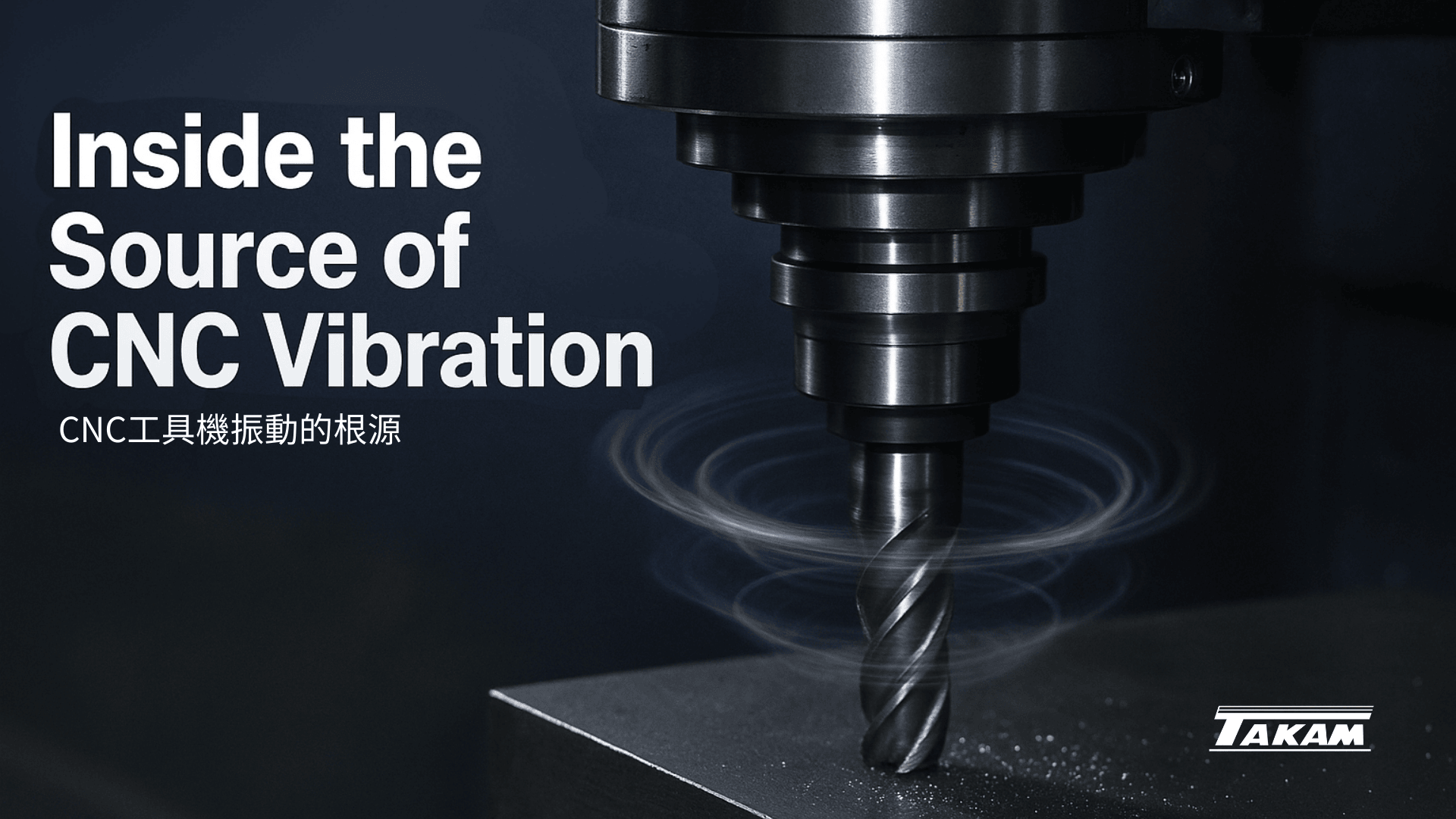
Vibration is often blamed for poor surface finish, shortened tool life, and unexpected spindle failures—but it is rarely fully understood.
In CNC machines, spindles and motors are not only power sources; they are also the primary channels through which vibration is generated and transmitted.
1. Rotor and Spindle Imbalance
One of the most fundamental vibration sources is rotational imbalance.
Even a small mass eccentricity in the motor rotor or spindle assembly can generate centrifugal forces when rotating at high speed. As spindle speed increases, the vibration force increases exponentially.
Common causes include:
- Manufacturing tolerances in rotors or spindle shafts
- Tool holders or drawbars with uneven mass distribution
- Wear or deformation after long-term operation
This type of vibration typically appears as speed-related vibration, becoming more severe at higher RPMs.
Dynamic balancing is the most effective method to control this issue, especially for high-speed CNC spindles.
2. Bearing-Related Vibration
Bearings play a critical role in spindle stability. Any imperfection or degradation in bearings will directly translate into vibration.
Typical bearing-related vibration sources include:
- Bearing preload inconsistency
- Raceway wear or fatigue
- Improper lubrication
- Contamination (dust, coolant ingress)
Unlike imbalance, bearing vibration often produces irregular or broadband vibration, which can worsen rapidly if not addressed.
Over time, excessive vibration accelerates bearing wear, creating a destructive feedback loop.
3. Motor Electromagnetic Forces
Not all vibration sources are mechanical. Electromagnetic vibration originates from the motor itself.
Common contributors include:
- Uneven air gaps between rotor and stator
- Magnetic force harmonics
- Inverter-driven motor torque ripple
These forces can induce periodic vibration, especially at specific speed ranges. While often subtle, electromagnetic vibration can significantly affect surface finish during fine machining.
Proper motor design, controller tuning, and motor–spindle integration are essential to minimize this type of vibration.
4. Tooling and Tool Holder Assembly
Even a perfectly balanced spindle can vibrate excessively if the tooling system is unstable.
Key factors include:
- Unbalanced tool holders
- Excessive tool overhang
- Poor tool clamping conditions
At high speeds, tooling imbalance often becomes the dominant vibration source, directly affecting surface roughness and tool life.
This is why many high-end CNC applications emphasize tool–holder balancing as a system, not just the spindle alone.
5. Structural Resonance and Machine Rigidity
Vibration is not only about rotating components—it is also about how vibration propagates through the machine structure.
Structural vibration sources include:
- Insufficient machine rigidity
- Weak motor mounting or spindle housing
- Resonance at specific natural frequencies
When spindle speed coincides with a structural resonance frequency, vibration amplitude can increase dramatically, even if individual components are balanced.
Machine design, casting quality, and assembly accuracy all influence this behavior.
6. Misalignment and Assembly Errors
Misalignment between the motor, spindle, and transmission components introduces cyclic loads that cause vibration.
Typical issues include:
- Motor–spindle axis misalignment
- Improper coupling installation
- Assembly tolerances stacking
These problems often lead to vibration at lower speeds and can be difficult to diagnose without proper measurement tools.
Why Dynamic Balancing Matters
Among all vibration sources, rotational imbalance is the most controllable—and often the most underestimated.
Dynamic balancing:
- Reduces vibration amplitude at operating speeds
- Extends spindle and bearing life
- Improves surface finish and dimensional accuracy
- Enhances machine reliability in continuous operation
For modern CNC machines, especially high-speed VMCs and HMCs, dynamic balancing is no longer optional—it is a foundation of performance.
Conclusion
Vibration in CNC spindles and motors is rarely caused by a single factor. It is the result of mechanical, electromagnetic, structural, and assembly-related influences interacting with each other.
Understanding these vibration sources allows machine builders and users to:
- Diagnose problems more accurately
- Make informed decisions about balancing, maintenance, and upgrades
- Achieve higher precision with greater machine longevity
In CNC machining, vibration control is not just about comfort—it is about accuracy, efficiency, and trust in the machine.
The Economic Impact of Micron-Level Quality.
From RS232 to USB: The Evolution of CNC Data Transfer