The Hidden Cost of Poor Chip Evacuation
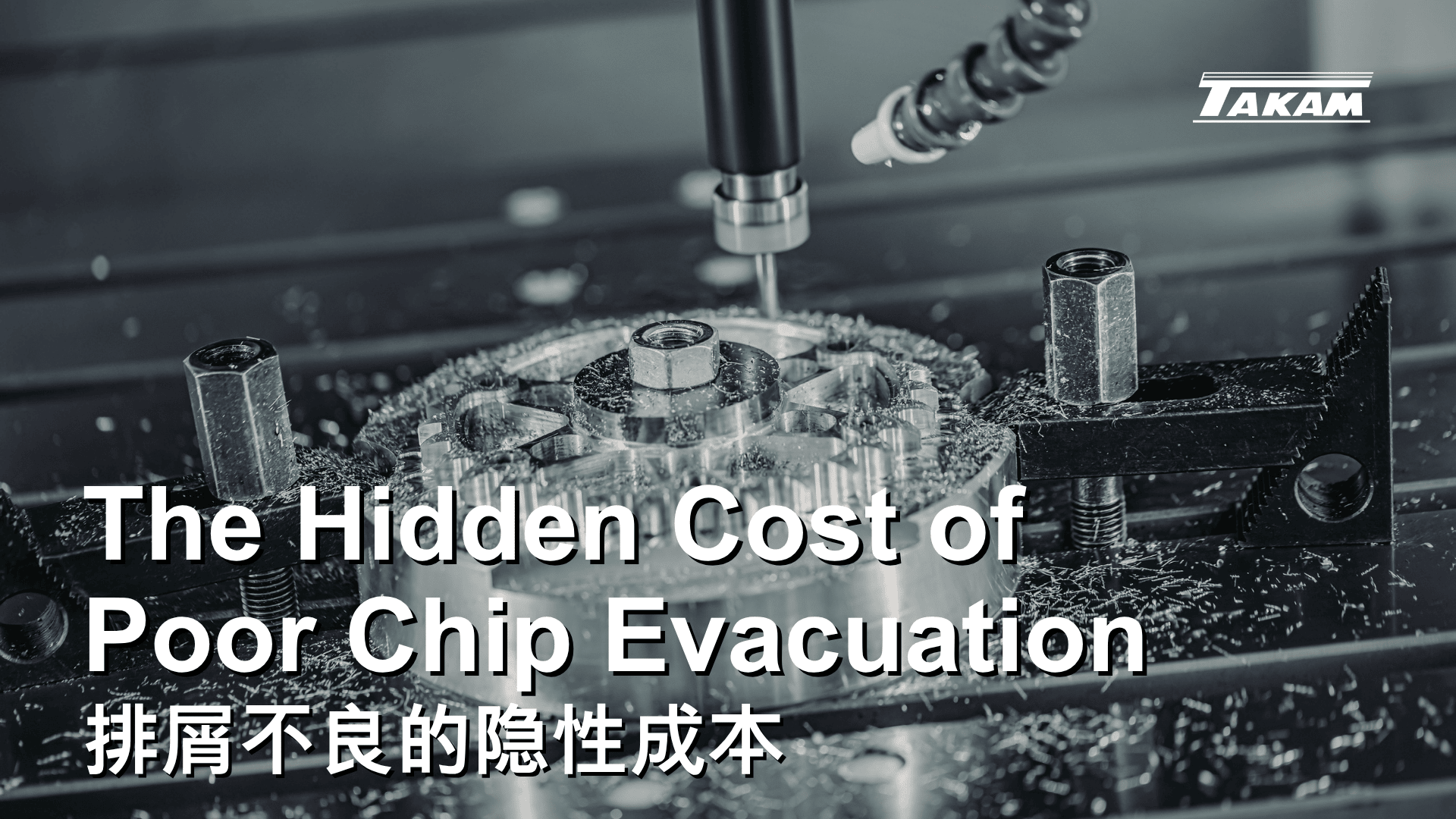
In CNC machining, chips are often treated as a small byproduct of the cutting process.
But in reality, poor chip evacuation can become one of the biggest hidden costs in manufacturing.
Many machining problems that appear to be related to tooling, spindle performance, or cutting parameters are actually caused by chips remaining in the cutting area for too long.
As production speeds continue to increase and automation becomes more common, effective chip control is no longer optional — it is essential.
Why Chip Evacuation Matters
During machining, chips are continuously generated between the cutting tool and the workpiece.
If these chips are not removed efficiently, they begin to create multiple problems inside the machining area.
Unlike coolant or cutting parameters, chip flow is often overlooked because operators become accustomed to “managing around” the issue instead of solving it at the source.
However, poor chip evacuation affects far more than cleanliness.
It directly impacts:
- Surface finish
- Tool life
- Machining stability
- Cycle time
- Machine downtime
- Automation reliability
Over time, these issues create significant hidden costs.
1. Reduced Surface Finish Quality
One of the first problems caused by poor chip evacuation is unstable surface finish.
When chips remain near the cutting zone, they can become trapped between the cutting tool and the workpiece.
This leads to:
- Scratches on the workpiece
- Inconsistent surface roughness
- Secondary cutting of chips
- Surface damage during finishing operations
In precision machining, even small surface imperfections can lead to rejected parts or additional polishing processes.
For industries such as aerospace, automotive, and medical manufacturing, stable surface quality is critical.
A machine may have excellent spindle accuracy and high-quality tooling, but if chips are not removed properly, machining quality will still suffer.
2. Shorter Tool Life
Chip accumulation also has a direct impact on cutting tools.
When chips wrap around the tool or remain inside the cutting area, cutting temperatures increase rapidly.
This creates:
- Excessive heat concentration
- Increased tool wear
- Unstable cutting loads
- Edge chipping and premature tool failure
In some cases, recutting chips can damage the cutting edge within seconds.
As tooling costs continue to rise, poor chip management becomes an expensive long-term problem.
Manufacturers often focus on upgrading cutting tools while ignoring the chip evacuation issues that are shortening tool life in the first place.
3. Unstable Machining and Vibration
Chips trapped in the machining area can also affect cutting stability.
During high-speed or heavy-duty machining, accumulated chips may interfere with tool movement or disrupt smooth cutting conditions.
This increases:
- Vibration
- Tool chatter
- Dimensional inconsistency
- Thermal instability
Once vibration begins, machining accuracy quickly decreases.
Even a highly rigid machine structure cannot fully compensate for unstable chip flow conditions.
This is why many modern machine tool designs place strong emphasis on chip evacuation systems, coolant flow optimization, and machine structure geometry.
4. Increased Machine Downtime
Poor chip evacuation also reduces productivity in ways that are not always obvious.
Operators may need to:
- Pause machining to remove chips manually
- Clean the machining area frequently
- Stop production due to chip alarms
- Perform additional maintenance
Over time, these interruptions increase downtime and reduce overall equipment efficiency.
In high-volume production environments, even a few minutes of unnecessary downtime per cycle can become a major operational cost.
Many manufacturers underestimate how much production time is lost due to poor chip control.
5. A Major Problem for Automation
As factories move toward automation, chip management becomes even more important.
In automated machining cells, there may be no operator constantly monitoring the machine.
If chips begin accumulating around the workpiece or tooling, problems can escalate quickly.
This may lead to:
- Tool breakage
- Workpiece damage
- Sensor interference
- Robotic loading errors
- Unexpected machine stoppages
For unmanned production, stable chip evacuation is one of the foundations of reliability.
A machine designed for automation must be able to manage chips consistently without depending on constant human intervention.
6. Machine Design Plays a Bigger Role Than People Think
Chip evacuation is not controlled by coolant alone.
Machine structure itself plays a critical role.
This is one reason why slant bed CNC lathes became increasingly popular in modern manufacturing.
Their angled structure allows gravity to help remove chips naturally from the cutting area.
Other important design factors include:
- Bed angle design
- Coolant delivery direction
- Conveyor system efficiency
- Internal machine layout
- Guideway protection
Good chip management is usually the result of an integrated machine design philosophy — not a single feature.
Final Thoughts
In machining, chips may seem small.
But their impact is not.
Poor chip evacuation affects quality, productivity, tool life, automation reliability, and long-term operational cost.
And unlike obvious machine failures, these losses often happen slowly over time, making them difficult to notice immediately.
That is why modern manufacturing places increasing importance on machine structures and chip control systems designed for continuous, stable production.
Because in CNC machining, productivity is not only about how fast a machine can cut.
It is also about how efficiently it can manage everything happening around the cut.
#CNC #Machining #CNCLathe #MachineTool #Manufacturing #PrecisionMachining #IndustrialAutomation
Dual Calibration: The Hidden Key to 5-Axis Accuracy
Flat Bed vs. Slant Bed — Why the Industry Changed