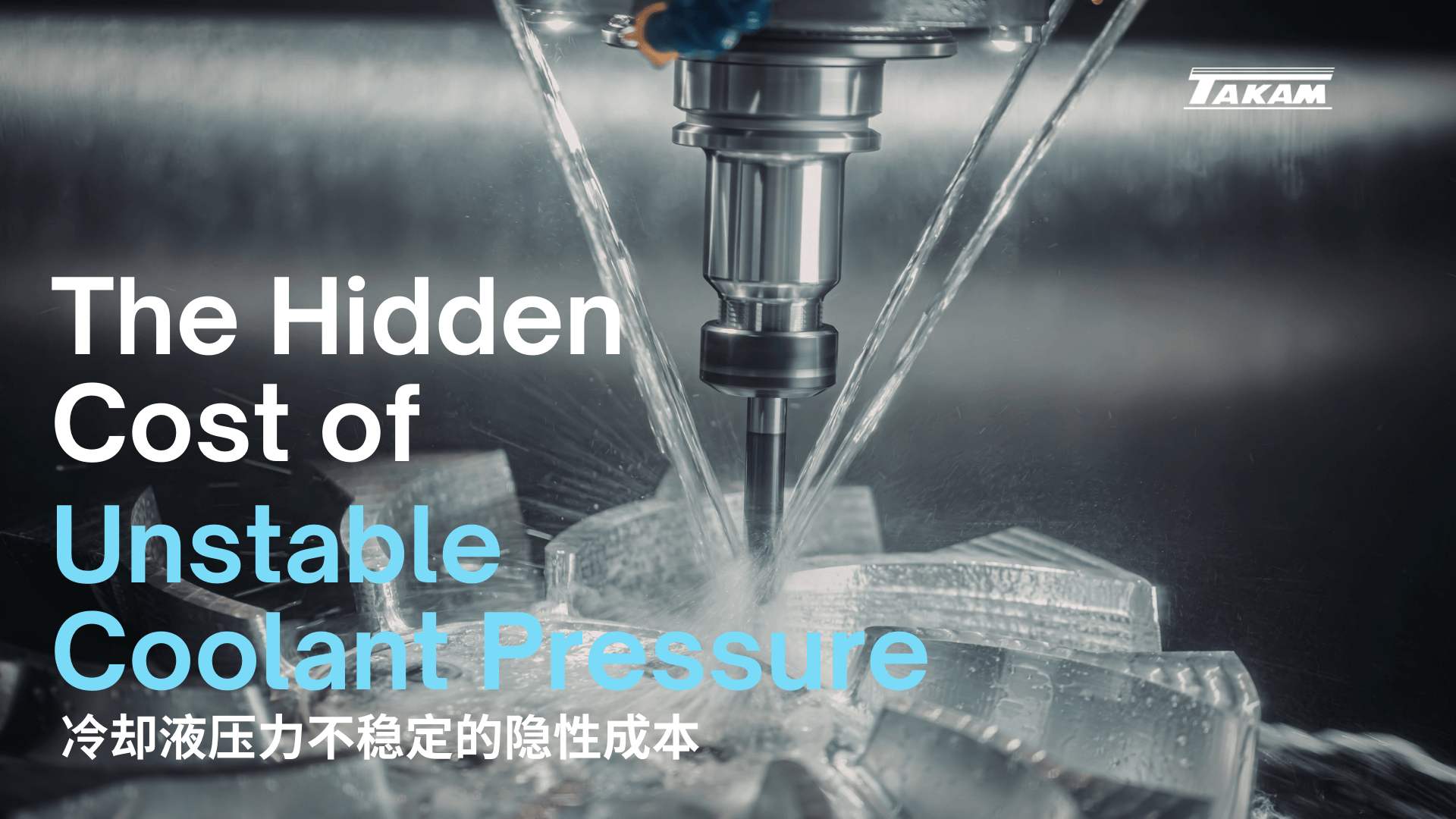
The Hidden Cost of Unstable Coolant Pressure
In CNC machining, costs rarely explode overnight. They accumulate quietly — cycle by cycle, tool by tool, shift by shift.
And one of the most underestimated contributors to this slow cost buildup is inconsistent coolant pressure.
Not a total failure. Not a dramatic alarm. Just inconsistency.
At first glance, coolant pressure seems like a background parameter — something that either exists or doesn’t. As long as coolant comes out, most operations assume the system is “working.” But in reality, stability matters far more than presence.
Because machining does not respond well to uncertainty.
Inconsistency Changes How Machines Are Used — Not Just How They Perform
When coolant pressure fluctuates, operators adapt. They may not even realize they are doing it.
Feeds are dialed back “just to be safe.” Depths of cut become more conservative. Programs that could be aggressive are intentionally softened.
None of these decisions appear in cost reports. Yet every one of them increases cycle time.
The machine still runs. Parts still come out. But productivity quietly erodes.
Over weeks and months, that erosion becomes far more expensive than any single hardware issue.
Tool Life Suffers First — and It’s Rarely Blamed Correctly
Tool wear is one of the earliest indicators of unstable coolant pressure, but it’s also one of the most misunderstood.
When tools fail prematurely, the usual suspects appear:
- Tool brand
- Coating
- Cutting parameters
- Material variation
Coolant pressure stability is rarely at the top of the list.
Yet when pressure fluctuates, heat evacuation becomes unpredictable. Chips may not clear consistently. Localized heat spikes occur without warning. Cutting edges experience thermal shock instead of steady cooling.
The result is not always dramatic breakage. More often, it’s irregular wear — the hardest kind to diagnose and the easiest to normalize.
“Tools don’t last as long as they used to” becomes an accepted reality.
And acceptance is expensive.
Scrap and Rework Are Only the Visible Costs
Dimensional drift caused by thermal instability doesn’t always trigger alarms.
Sometimes tolerances are still met — barely. Sometimes surface finishes degrade without crossing rejection thresholds. Sometimes parts pass inspection but cause problems downstream.
These are not recorded as coolant-related losses. They show up as quality issues, assembly problems, or customer complaints.
By the time the dots are connected, the root cause is already buried under layers of secondary effects.
This is how inconsistency hides.
Unstable Coolant Pressure Undermines Automation the Most
For shops moving toward unattended or lights-out machining, coolant pressure stability becomes non-negotiable — even if it isn’t labeled that way.
Automation depends on predictability. Not peak performance. Not maximum pressure. Predictability.
A system that performs well 80% of the time is unacceptable when no operator is present to intervene. Small fluctuations that are manageable during staffed shifts become critical risks overnight.
That’s why many automation projects fail quietly:
- Programs are capable
- Machines are capable
- Control systems are capable
But supporting systems are inconsistent.
And coolant is one of the most unforgiving.
The Management Cost No One Calculates
From a management perspective, inconsistency creates a different kind of cost: decision paralysis.
When results vary without clear cause, process improvements slow down. Engineers hesitate to optimize. Production planners avoid pushing capacity. Continuous improvement becomes guesswork instead of analysis.
Stable systems enable confident decisions. Unstable systems force defensive ones.
This difference shapes a shop’s culture more than most people realize.
Pressure Isn’t the Point — Stability Is
This is where many discussions go wrong.
The problem is not “insufficient pressure” in isolation. It’s pressure that cannot be relied on.
A lower, stable pressure often produces better real-world results than a higher pressure that fluctuates under load, contamination, or temperature changes.
Consistency allows:
- Repeatable heat control
- Predictable chip evacuation
- Reliable tool performance
- Confident process optimization
Without it, every improvement effort rests on unstable ground.
The True Cost Is Accumulation
No single incident exposes the full cost of inconsistent coolant pressure.
It accumulates as:
- Longer cycle times
- Shorter tool life
- Conservative programming
- Reduced confidence in automation
- Slower process improvement
Each factor alone seems manageable. Together, they define the ceiling of a shop’s performance.
And once that ceiling is accepted, it becomes invisible.
Final Thought
In CNC operations, the most expensive problems are rarely the loudest ones.
They are the systems that “almost” work. The parameters that “usually” hold. The performance that is “good enough.”
Coolant pressure inconsistency falls squarely into that category.
Not because it stops production — but because it slowly teaches everyone to expect less from the machine.
And that expectation, more than any component, determines long-term cost.
What Really Determines CNC Machine Uptime
Dual Calibration: The Hidden Key to 5-Axis Accuracy