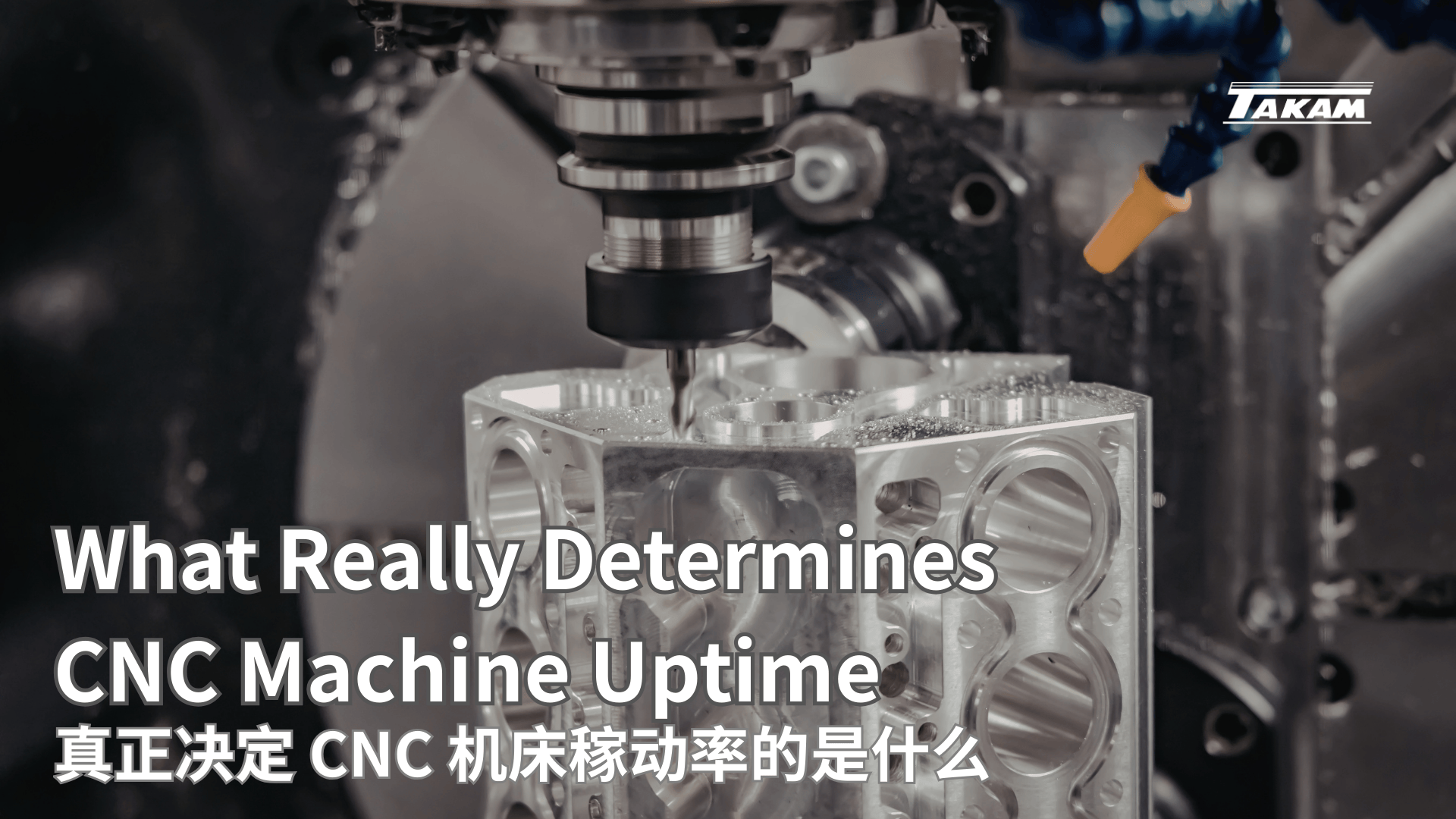
What Really Determines CNC Machine Uptime
In manufacturing, uptime is often treated as a number.
A percentage on a report.
A KPI on a dashboard.
A metric reviewed after something has already gone wrong.
But for those who work closely with CNC machines, uptime is not a statistic — it’s a result. And that result is shaped long before a machine is powered on.
Uptime is not determined by one component, one feature, or one specification. It is the outcome of hundreds of design decisions, operating habits, and system interactions working together — or against each other.
Uptime Is Built, Not Claimed
Machine builders often talk about performance: speed, acceleration, spindle power, positioning accuracy. These figures are easy to present and easy to compare.
Uptime, however, is harder to sell — because it cannot be guaranteed by a single parameter.
A CNC machine does not lose uptime all at once. It loses it gradually.
Through small stoppages.
Through alarms that appear more frequently.
Through interventions that become routine.
By the time uptime is visibly affected, the underlying causes have usually been present for a long time.
The Difference Between Running and Running Reliably
Most CNC machines can run.
The question is whether they can run consistently, predictably, and without supervision.
In real production environments, uptime depends less on peak performance and more on how a machine behaves under repetition. Thousands of tool changes. Continuous thermal cycling. Varying operators. Changing part programs.
Machines that look identical on paper can behave very differently over time.
This is where uptime quietly separates good machines from dependable ones.
Mechanical Stability Sets the Baseline
Before software, before automation, before optimization — mechanical stability sets the baseline for uptime.
Rigid structures resist deformation.
Balanced moving assemblies reduce wear.
Stable interfaces maintain alignment over time.
When these fundamentals are compromised, no amount of control tuning can fully compensate.
Mechanical instability does not always cause immediate failure. More often, it causes gradual degradation: vibration, noise, premature wear, and eventually unplanned downtime.
Machines designed for long-term uptime are often conservative in appearance — but deliberate in execution.
Thermal Behavior Is an Uptime Issue
Heat is unavoidable in machining. How a machine manages it determines how long it can run without interruption.
Thermal growth affects positioning accuracy, tool engagement, and component life. If unmanaged, it leads to alarms, compensation limits, and operator intervention.
Stable uptime requires more than cooling capacity. It requires predictable thermal behavior.
Machines that warm up evenly, respond consistently, and return to known conditions reduce uncertainty — and uncertainty is the enemy of uptime.
Reliability Lives in the “Uninteresting” Systems
When uptime drops, attention often goes to visible systems: spindle, controller, axes.
But many interruptions originate elsewhere.
Tool magazines that hesitate.
Chip conveyors that jam.
Lubrication systems that drift out of range.
Sensors that misread, not fail.
These systems are rarely highlighted, yet they operate continuously. Their reliability determines whether a machine can sustain long runs without attention.
Uptime is often lost not through catastrophic failure, but through repeated minor interruptions.
Automation Exposes Every Weak Link
Automation does not create problems — it reveals them.
In unattended or lights-out machining, machines lose the safety net of human correction. Small inconsistencies that operators once compensated for become hard stops.
Tool management, chip evacuation, thermal drift, and recovery logic suddenly matter far more than peak cutting speed.
A machine that is “fast” but unpredictable will struggle in automated environments. A machine that is stable and repeatable may appear slower — but will produce more over time.
This is where uptime becomes a design philosophy, not an operational afterthought.
Uptime Depends on Human Interaction
Even the best-designed CNC machine relies on people.
Clear maintenance access.
Logical alarm messages.
Consistent behavior across shifts.
Machines that are difficult to understand or maintain lose uptime through hesitation and misinterpretation.
Designs that anticipate real shop-floor behavior — rushed operators, mixed skill levels, imperfect conditions — preserve uptime by reducing dependency on individual expertise.
Good machines forgive mistakes. Fragile ones amplify them.
Measuring What Actually Matters
Uptime improves when it is measured honestly.
Not just scheduled uptime, but effective uptime.
Not just machine-on time, but productive time.
Not just failures, but frequency of intervention.
The most valuable insights often come from asking simple questions:
-
Why did the machine stop?
-
How long did it take to recover?
-
Could it have recovered on its own?
These answers rarely point to a single cause — they point to systems.
Rethinking Uptime as a System Outcome
True CNC machine uptime is not the result of one “hero” feature.
It is the cumulative effect of:
-
Mechanical integrity
-
Thermal predictability
-
Reliable peripheral systems
-
Automation readiness
-
Human-centered design
Machines with high uptime are rarely dramatic. They are quietly consistent.
They don’t demand attention.
They don’t surprise operators.
They don’t rely on constant correction.
They simply keep running.
Final Thoughts
In the end, uptime is not something you add to a machine.
It is something you design for, maintain, and respect.
The most reliable CNC machines are not defined by how fast they cut — but by how rarely they stop.
And that is what really determines CNC machine uptime.
What Every CNC Cycle Depends On
The Hidden Cost of Unstable Coolant Pressure