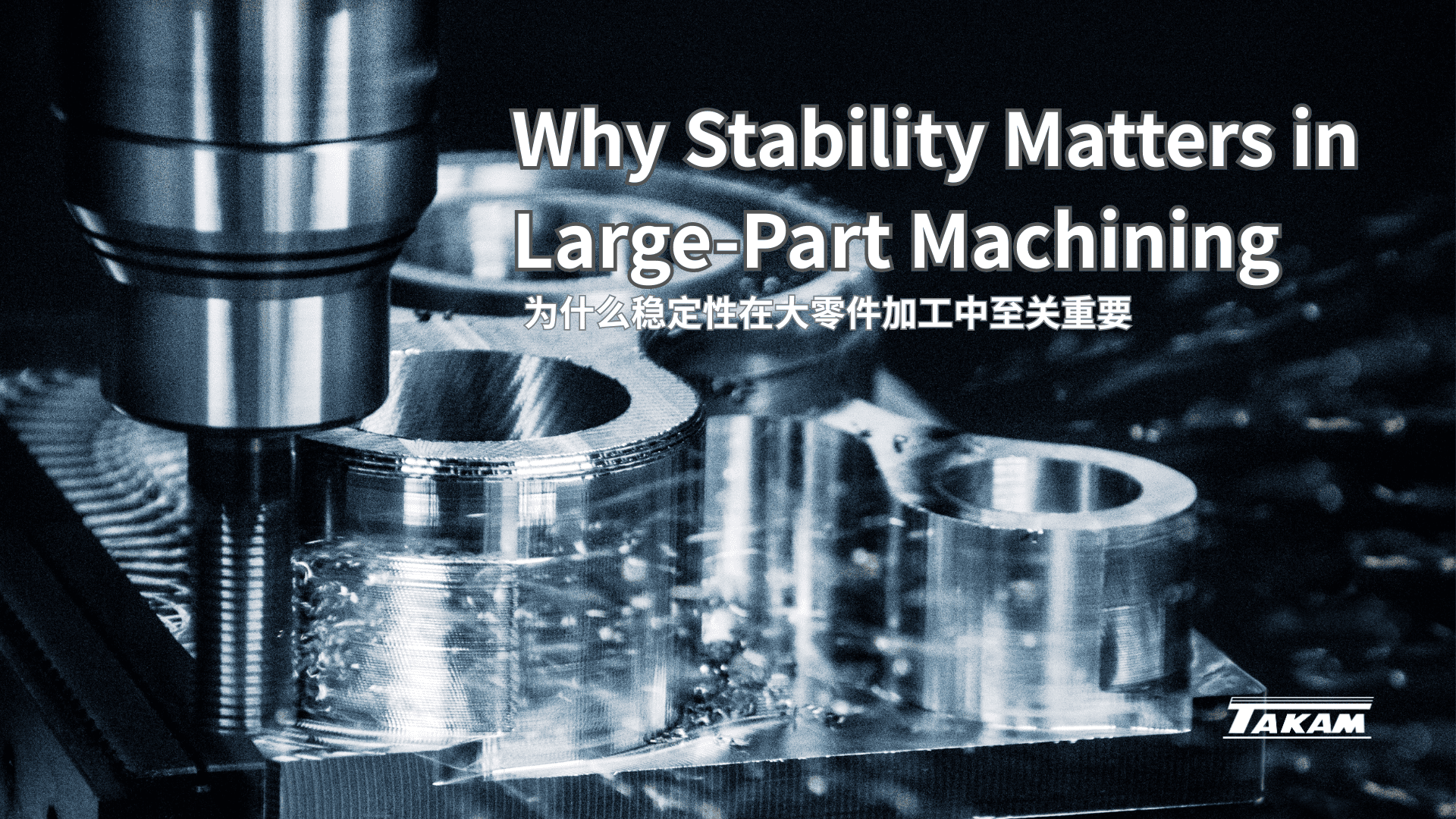
Why Stability Matters in Large-Part Machining
In large-part machining, speed is often the first metric discussed. Spindle RPM, rapid traverse rates, cutting feed—all measurable, all impressive on paper.
But anyone who has worked with large CNC machines knows a simple truth: when parts get big, stability matters far more than speed.
As workpieces grow in size and mass, the challenges of machining shift dramatically. What works for small or medium-sized parts does not scale linearly. In fact, many problems become exponentially harder to control.
Large Parts Change the Rules of Machining
Large components—such as structural frames, molds, energy equipment, or aerospace parts—bring unique constraints:
- Long machining cycles, often lasting many hours or even days
- High material removal combined with significant tool engagement
- Large thermal loads from both the machine and the environment
- Complex fixturing and workpiece deformation
At this scale, machining is no longer just about cutting efficiently. It becomes a test of how well the entire system behaves over time.
Why Speed Loses Its Advantage
High speed can be an advantage in small-part production, where cycle times are short and thermal effects are minimal. In large-part machining, however, aggressive feeds and rapid movements often introduce new problems:
- Increased vibration and chatter
- Thermal growth of machine structures
- Tool wear instability over long runs
- Loss of dimensional consistency from start to finish
When a machining cycle lasts 12 or 24 hours, even minor instability compounds into measurable errors. A few microns of drift per hour can turn into tenths of a millimeter by the end of the process.
In these situations, faster is not better. Predictable is better.
Stability Is a System-Level Requirement
Stability in large-part machining does not come from a single component. It is the result of a carefully balanced system.
Key contributors include:
Machine Structure A rigid, well-proportioned structure minimizes deformation under cutting forces. In large machines, mass distribution, rib design, and joint integrity matter more than raw acceleration numbers.
Thermal Management Large machines generate and absorb heat continuously. Without proper thermal symmetry and compensation strategies, positioning accuracy drifts over time—even if the machine is perfectly calibrated at startup.
Motion Control Consistency Smooth, repeatable axis movement is more important than peak speed. Servo tuning, preload quality, and damping characteristics define how reliably the machine returns to the same position hour after hour.
Foundation and Installation Unlike smaller machines, large CNC systems interact strongly with their foundations. Floor rigidity, leveling, and long-term settlement directly influence machining stability.
Long Cycles Demand Predictability
One defining feature of large-part machining is time. Long cycles expose every weakness in a process:
- Tool offsets must remain stable
- Probing results must be repeatable
- Axis behavior must not drift with temperature
A machine that performs well for the first hour but degrades over time cannot be considered production-ready for large parts.
This is why experienced manufacturers prioritize machines that behave consistently throughout an entire shift—or across multiple shifts—rather than those optimized for short bursts of speed.
Stability Enables Accuracy, Not the Other Way Around
Accuracy is often presented as a static specification. Stability is dynamic.
Without stability:
- Accuracy cannot be maintained
- Compensation strategies become unreliable
- Automation becomes risky
With stability:
- Small positioning offsets can be compensated
- Processes become repeatable
- Quality becomes predictable
In large-part machining, stability is what allows accuracy to survive reality.
Rethinking Performance Metrics
When evaluating large CNC machines, traditional performance metrics deserve reconsideration.
Instead of asking:
- How fast can it move?
- How high is the spindle speed?
Better questions are:
- How does it behave after 10 hours of continuous cutting?
- How sensitive is it to temperature changes?
- How repeatable are its results day after day?
These questions reveal far more about real-world capability than any single speed figure.
Conclusion
Large-part machining is not about pushing limits—it is about controlling variables.
As parts grow larger, success depends less on speed and more on stability, consistency, and system-level design. Machines that prioritize these qualities may not always look impressive on a specification sheet, but they deliver where it matters most: on the shop floor, over time, in real production.
In the world of large CNC machining, stability is not a compromise. It is the foundation.
Accuracy vs. Repeatability in CNC Machining
What Every CNC Cycle Depends On